
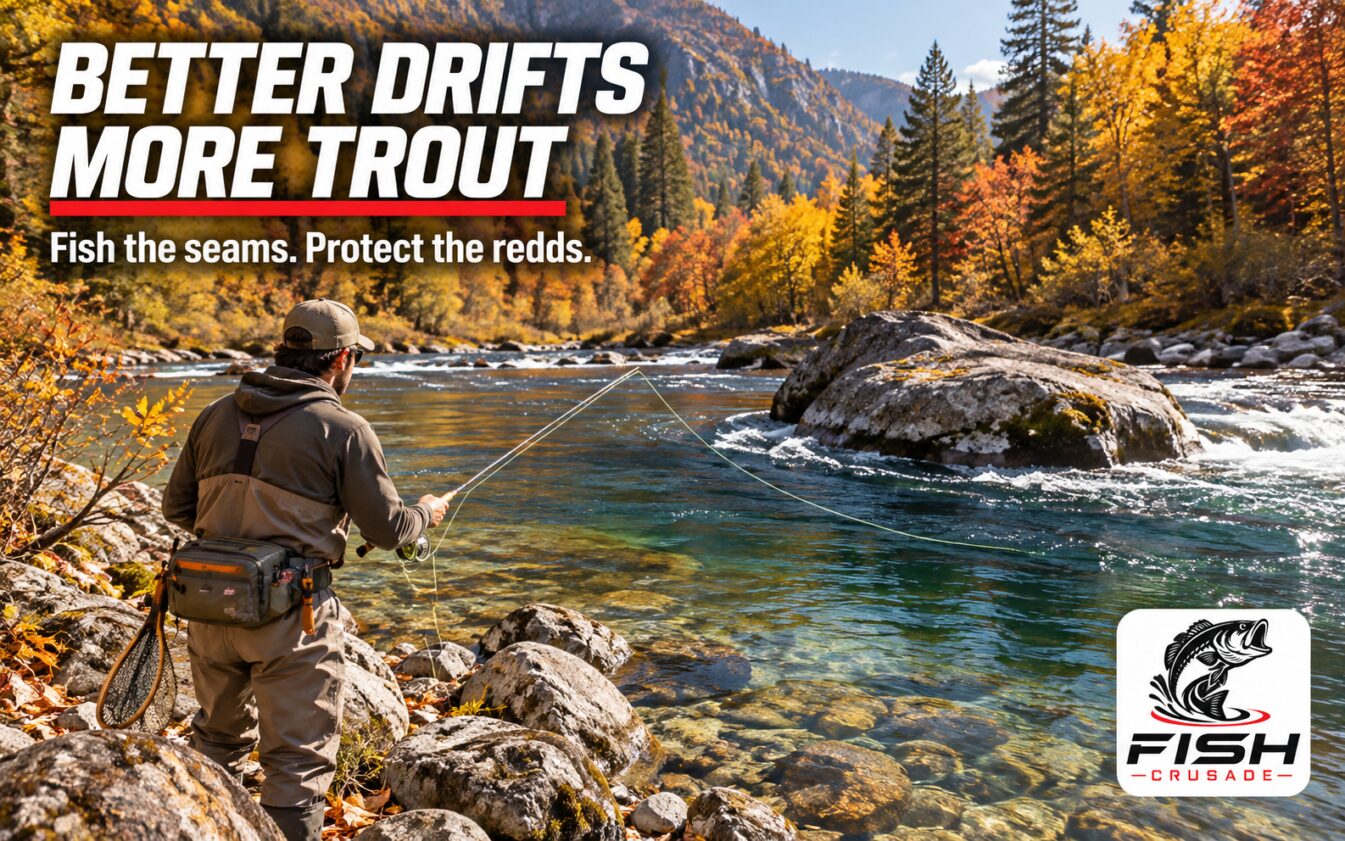
A trout stream can look quiet on top while still offering places to fish below the surface. When a dry fly is drawing no interest, a nymph lets you explore the water carrying food past sheltered fish. The challenge is getting a convincing drift rather than simply getting a fly wet.
In fall, there is another decision to make before the first cast: where can you fish without disturbing spawning trout or the gravel holding their eggs?
Read the Current Before Picking a Fly
Fly Fisherman’s nymphing primer explains the relationship between a feeding lane and nearby shelter. Eddies, seams and deeper runs beside faster current let trout intercept food without occupying the hardest flow. Look for those connections instead of treating an entire pool as one target.
Troutbitten’s single-seam advice offers a useful next step: choose a short section you can reach and control. A cast that crosses several different current speeds can be harder to manage than one that follows a single lane. Watch what the leader or indicator does through the drift. An abrupt pull across the seam is a reason to rethink your position.
Adjust Depth Without Anchoring the Fly
The same Fly Fisherman guide stresses reaching the feeding zone and maintaining contact well enough to notice a take. Use an appropriate weighted fly or permitted added weight, then adjust when repeated drifts show that the presentation is not getting down. Continually dragging into snags is a reason to lighten up or change the drift.
New York DEC’s stream-trout guidance adds useful fundamentals: approach carefully, minimize disturbance, and investigate protected water around rocks and other cover. Its starter fly selection includes familiar nymphs such as a Hare’s Ear or Prince. Those are examples to begin with, not mandatory patterns for every watershed.
Orvis also emphasizes watching for a hesitation that signals a take. Before replacing your whole fly box, try another casting angle or a more manageable length of line. The aim is a fly moving naturally through a plausible feeding lane, with enough awareness to respond when the drift hesitates.
Recognize Gravel That Deserves Space
Fly Fisherman’s guide to redds describes the spawning beds used by fall-spawning brook and brown trout. Look for disturbed, cleaner-looking gravel or a shallow depression contrasting with the surrounding streambed. Fish may be present, but an empty-looking bed can still contain eggs.
Do not walk across suspected redds or deliberately cast to adults occupying them. Stepping nearby can also disturb sediment. If you cannot identify a safe route, stay on the bank or choose another stretch. A visible fish is not automatically an appropriate fish to target.
Build a Better Stream Session
- Watch first. Identify both a feeding seam and the route you will use to approach it.
- Make a controlled drift. Start close enough to manage the line without crowding the fish.
- Change presentation before everything else. Compare depth, angle and line control before cycling through numerous patterns.
- Leave spawning areas alone. Move to suitable non-spawning holding water rather than working around fish on redds.
Stream classifications, seasons and permitted tackle vary. Check the exact water before fishing. When releasing trout, follow DEC’s handling principles: wet hands, minimal handling and a prompt return to the water. Clean your wading gear between waters, and let another angler enjoy some elbow room.