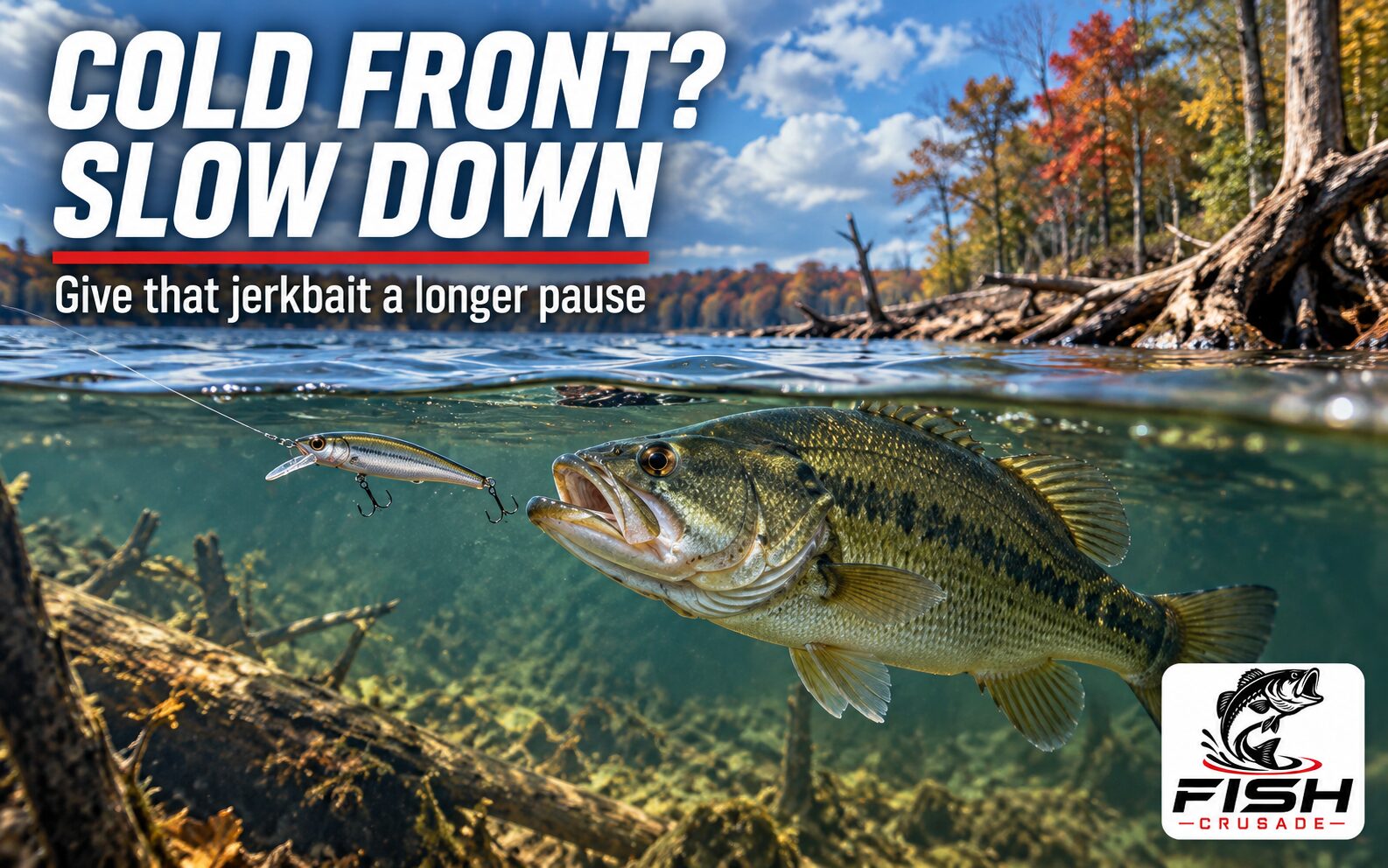
The bank that produced yesterday can seem lifeless after a cold front. Before you decide the bass have disappeared, change the question: are you fishing where they moved, and is your lure spending enough time there?
A suspending jerkbait gives you a way to investigate both. This is an evergreen approach for cooling-water bass, built from established fishing guidance rather than a claim about today’s bite on every American lake.
Check the Nearby Water First
In a November 2024 Bassmaster column, Scott Martin describes bass shifting away from shallow feeding areas after a stronger fall temperature drop. His important observation is proximity: fish may settle in nearby deeper water rather than leave the area entirely. He recommends slowing down with jerkbaits or minnow-style presentations.
That suggests a useful first adjustment. If fish were feeding on a point or along a bank, work the next break or outside edge before abandoning the stretch. Martin’s depth examples reflect his experience; they are not a universal prescription. Your lake’s clarity, cover and actual baitfish location still matter.
Give the Pause a Purpose
Rapala’s fall jerkbait guidance emphasizes matching running depth and extending pauses as water cools. A lure repeatedly passing above or below fish is a different problem from a lure moving too quickly through them. Address depth first, then experiment with cadence.
Begin with a repeatable sequence of short twitches and a pause. Make several casts with the same rhythm, then try a longer pause on the next pass. Avoid assigning a magic number of seconds to every situation. Let follows, strikes and the absence of interest guide the adjustment.
A suspending model is designed to linger, but check what your particular bait does beside the boat or bank. A lure that slowly rises or sinks behaves differently during a long stop. Understanding that behavior is more useful than assuming every package marked suspending produces the same result.
Choose a Stretch Worth Testing
Wired2Fish’s fall overview highlights points, wind-influenced banks and remaining healthy vegetation. Those are places to investigate, not promises of fish. Combine a likely location with evidence of bait or recent bites, then give your presentation a fair test.
For shore anglers, an accessible point with room to cast can be more practical than trying to force a treble-hook lure through thick branches. Kayak anglers can work parallel to an edge while keeping enough distance for an effective retrieve. Stay within safe wind conditions rather than chasing an exposed shoreline.
A Simple Plan for the Next Front
- Return with a question. Mark where yesterday’s bites came from, then check the nearest depth change.
- Change one thing. Test running depth before changing pause length, color and location all at once.
- Record the response. A follow is useful evidence even when the fish does not commit.
- Keep an alternative ready. If fish resume chasing, try a moving bait again instead of insisting on a slow presentation.
Bring pliers for treble hooks, wear a life jacket afloat, and check local fishing rules before keeping bass. The goal is a controlled adjustment, not spending the whole day repeating a retrieve the fish have already ignored.