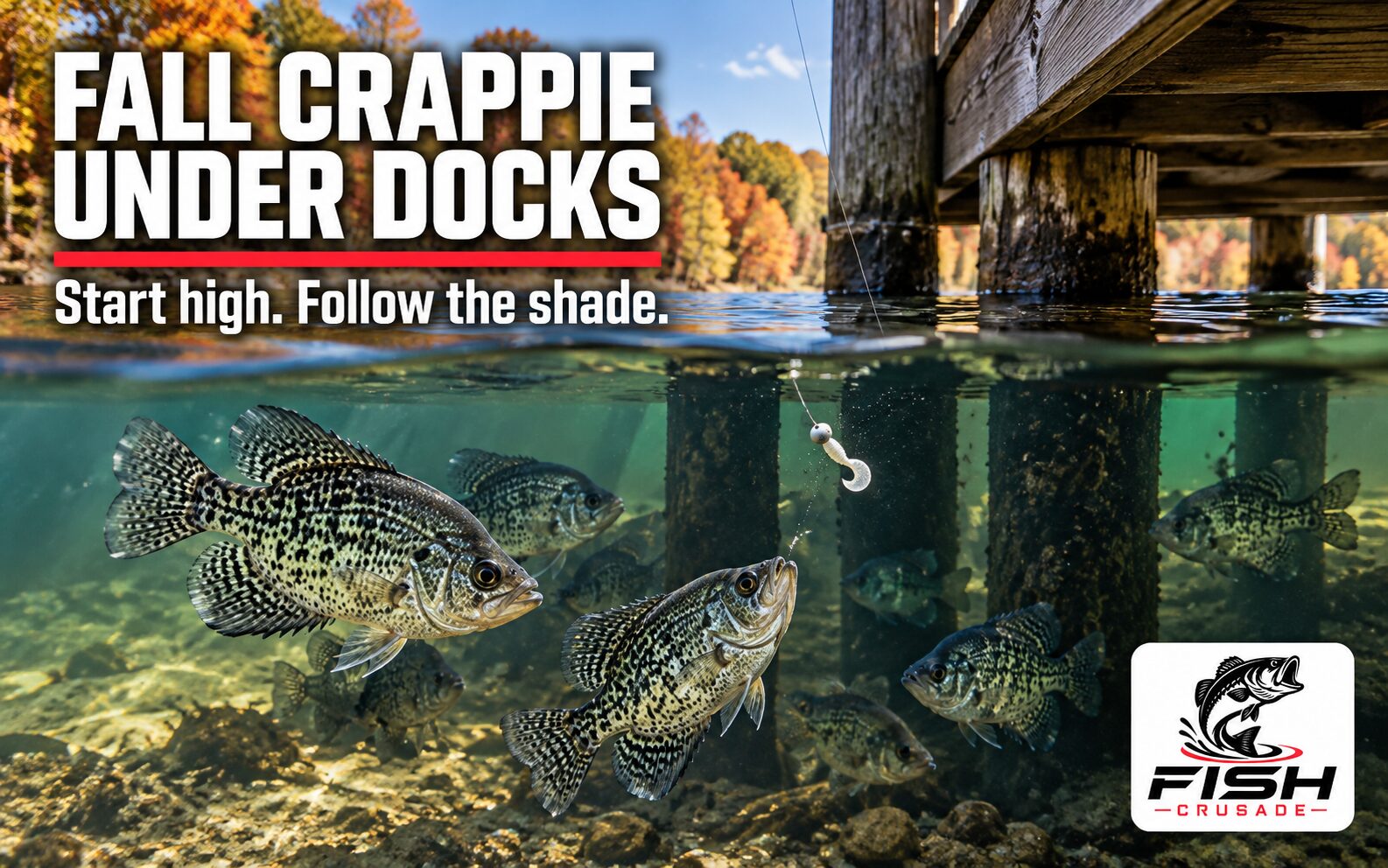
A dock can hide more than one fishing opportunity. There is the obvious bottom beside the posts, but there is also the shaded water above it. If every cast goes straight to the bottom, you may be skipping the level where crappie are holding.
The fall dock approach is a search for the right depth and position. It does not require every dock to be full of fish, and it does not require expensive electronics to begin.
Find Cover With Somewhere to Go
In In-Fisherman’s September 2025 panfish feature, Steve Ryan reports Illinois guide Reagan Smith’s approach to fall crappie. Smith checks docks and other cover associated with deeper water, and notes that some larger fish can hold high under the shade. His regional temperature observations describe his lakes, not a nationwide arrival date.
Carolina Sportsman’s reporting on Danny Sisson likewise connects fall dock fishing with nearby deep water. For a practical first stop, consider a dock near a point, channel edge or other depth change. Work the shade deliberately. As light changes, compare one side with the other instead of assuming the same corner stays best all day.
Smith uses dock shooting to reach difficult spaces. That is a specialized casting method, not a requirement. An ordinary controlled cast or a vertical presentation from a lawful access point can help you test the same basic idea without handling a loaded rod and exposed hook.
Keep the Jig in View of the Fish
Iowa DNR describes small lead-head jigs as versatile crappie lures and notes that crappie often rise to take a presentation. A small float can hold a jig above cover, while fishing without one lets you explore different levels on the fall.
Start with a manageable small jig and a repeatable retrieve. On the first casts, give it only a short settling period. Then allow a little more time on successive casts. The countdown is a comparison tool, not a precise depth measurement: jig weight, line and wind all affect the result.
A bite on the drop deserves attention. Repeat the angle and settling time before changing lures. Iowa also cautions that a forceful hook-set can tear a crappie’s delicate mouth. A controlled lift is a better goal than a bass-style swing.
Let the Catch Set the Next Depth
Missouri’s Department of Conservation advises exploring woody cover at different depths rather than getting locked into one seasonal rule. Its vertical-jigging guidance emphasizes remembering the depth where a fish bites and concentrating there.
Apply that principle to the dock: record whether the bite came high, halfway down a post or near adjacent brush. If nothing happens, try the outer edge or another dock. One empty pocket does not prove that the whole shoreline is unproductive.
A Dock-Side Checklist
- Begin above the cover. Give shallow-holding fish a chance before sending the jig deeper.
- Repeat good casts. Match the angle and fall that produced a bite.
- Watch the line. A change during the fall may be more noticeable than a hard strike.
- Respect the property. Use public or permitted access, avoid occupied docks and boats, and never climb onto a private dock to retrieve tackle.
Bank and kayak anglers can use the same depth-testing process wherever access allows. Keep casts clear of other people, check local size and harvest rules, and leave dock owners with a reason to welcome careful anglers back.