Regulation check — October 25, 2026: North Carolina’s 2026 fall recreational flounder harvest season ended September 14. NC DMF also discourages targeting flounder for catch and release because release deaths count against recovery goals. Florida’s annual flounder harvest closure runs October 15 through November 30. South Carolina and Georgia have their own rules; consult the official agency links below for the water you will fish. This article is a technique reference, not an invitation to keep flounder during a closure.
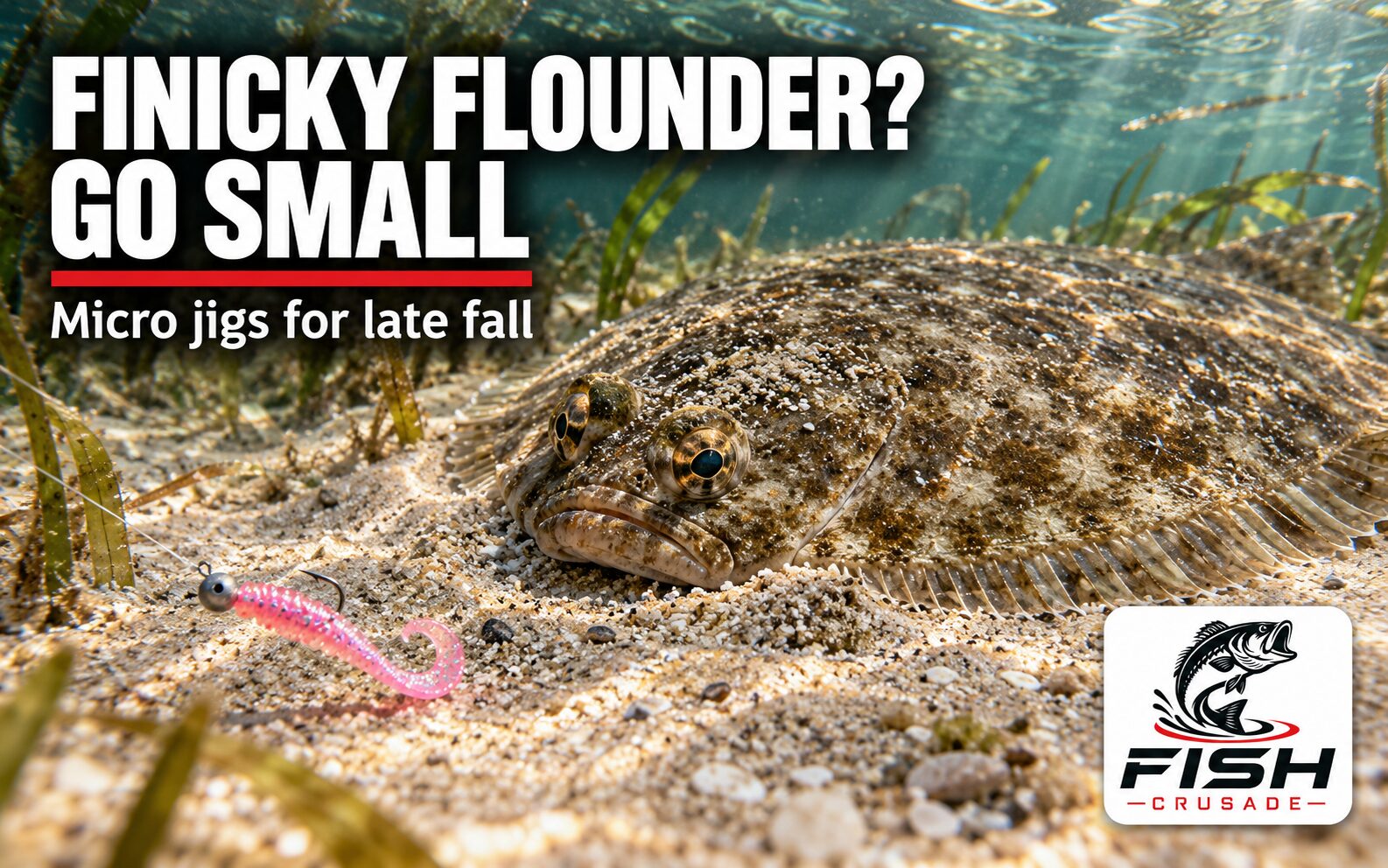
Most flounder anglers reach for the same proven soft plastic all season long. But as fall wears on and the water clears and cools, flounder can get finicky. One answer, according to a Sport Fishing magazine how-to by Chester Moore, updated September 3, 2024, is to go smaller than feels natural.
Why Small Baits Work This Time of Year
Moore describes watching flounder in a clear Texas canal turn down everything he showed them on a late-fall day. After switching to a 2-inch curly-tail grub, about half the size of his usual lure, he reported catching and releasing 17 fish. That is his historical account, not a predicted catch rate.
His explanation offers a tactic to test where local conditions and regulations allow. Flounder are ambush feeders that tend to eat what the current brings them. In late fall and winter, that is often tiny baitfish and small crustaceans. A smaller lure matches what they are already seeing.
The Micro-Jig Setup
The article keeps the gear simple. Moore fishes these tiny grubs on 1/16-ounce jig heads with a medium-light or medium-action spinning outfit spooled with 8-pound fluorocarbon. He favors fluorocarbon for clear-water finesse fishing. Visibility and abrasion performance depend on the line, diameter and conditions; no line is invisible or abrasion-proof.
Interestingly, every small lure he lists comes from the freshwater aisle: 2- to 2.5-inch curly tails and small shad bodies sold for crappie. That is good news for Southeast anglers who already have a crappie box at home. For color, his rule is louder shades like pink in dingy water and natural, translucent colors in clear water.
He reports getting more bites on light gear, while also losing some fish. Use tackle strong enough to land fish promptly, particularly around docks and oysters.
Slow Down and Wait on the Bite
Retrieve speed may be the biggest key. Moore crawls the lure slowly along the bottom and only speeds up if nothing is biting. As he puts it, “If you think you’re fishing too slow, you’re probably not fishing slow enough.”
Moore describes different hook-set delays for hard and light bites, including a long pause after a light tap. That is his personal technique rather than a universal rule. When fish must be released, avoid deliberately letting them swallow a jig: maintain contact, respond when you feel the fish’s weight, and prioritize a clean mouth hookup and quick release.
He also notes that flounder do not scatter much this time of year. Once you find a productive spot, stay and work it thoroughly.
Where to Look in the Southeast
Moore’s examples come from the Gulf. Applying the same approach to the Carolinas, Georgia or Atlantic Florida is an adaptation to test, not a verified regional forecast. He favors canals and shorelines with quick access to deep water, because flounder move deep when it cools and come back shallow to feed when it warms. Channels leading toward the open water are often productive late in the season. His south-wind and warmer-water observations are Gulf Coast examples. On another coast, judge local wind direction, shoreline exposure, tides and water temperature rather than assuming a south wind has the same effect.
For bank anglers, dock lights, canal seawalls and bridge shorelines near a channel are worth a slow pass with a micro jig. Kayak anglers can quietly work the edges of creek mouths where shallow flats drop into deeper water.
Keep Flounder in Mind for the Future
Moore says he releases all flounder 20 inches or longer as a personal conservation practice, not a legal size rule, and encourages others to do the same, noting that southern flounder stocks have been under strain. Flounder harvest rules differ substantially by state; do not assume the same closure or limit applies across the Southeast. Many anglers on light tackle choose to release most of their catch. Wet your hands before handling, and get fish back in the water quickly.
Anglers should check their state’s current flounder regulations, including season dates, before keeping any fish.