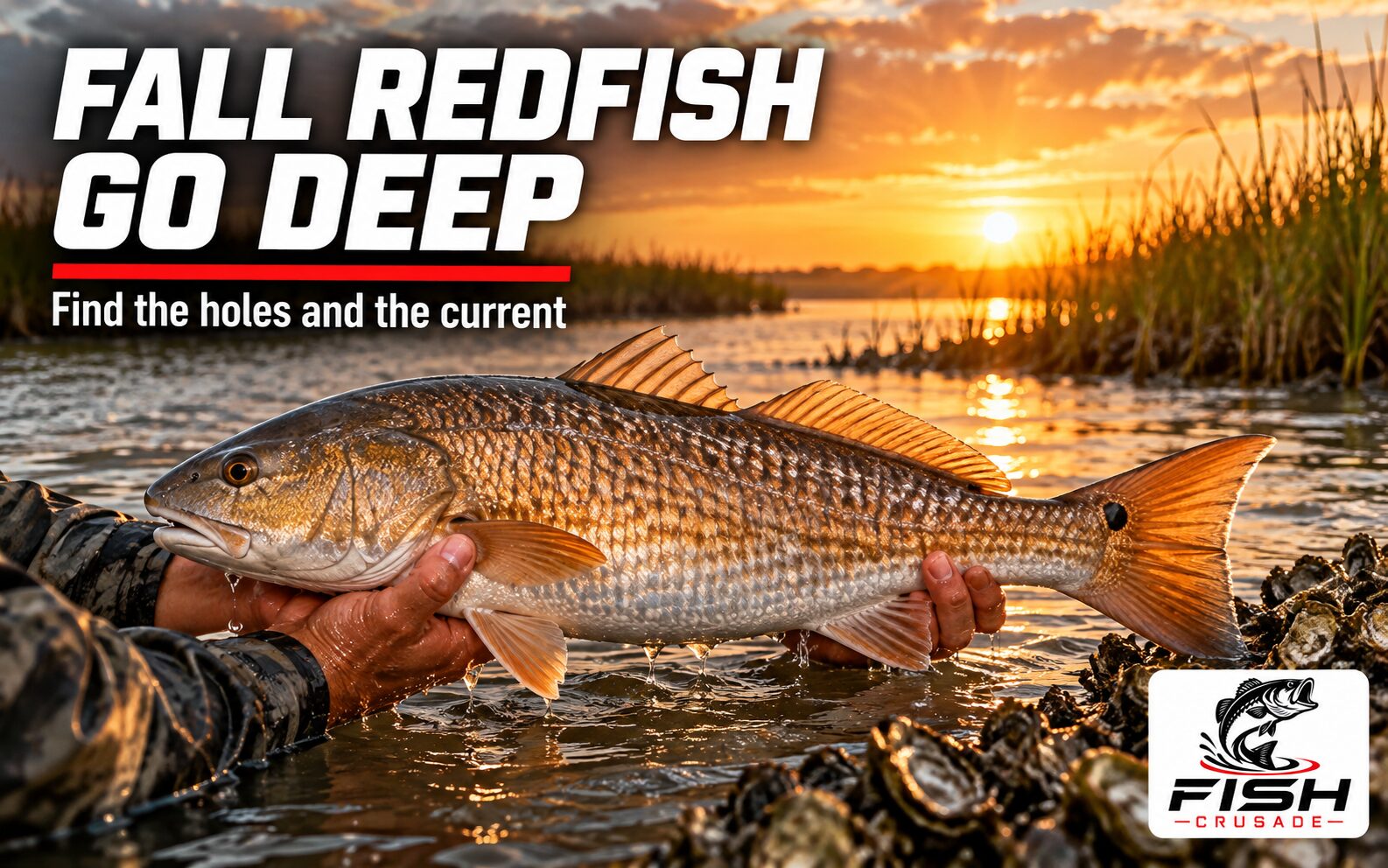
The summer flats that held tailing redfish a few weeks ago can feel empty once October settles in. The fish have not gone far. Cooling conditions can move some reds toward deeper, protected water. Treat that as a pattern to investigate rather than a rule that every fish leaves the flats.
Salt Water Sportsman laid out this seasonal pattern in Sid Dobrin’s evergreen article dated September 13, 2018. It is a tactics reference, not a current local fishing report. The core idea is simple: “When the weather cools, redfish move into sheltered inshore waters.” According to the article, the trigger is water temperature dropping into the mid-to-low 70s. From there, reds gather near creek and river mouths, channels, deep cuts and points.
Where the Reds Go When the Water Cools
The article points anglers toward holes in the 2- to 10-foot range, and it stresses that a depression does not have to be dramatic to matter. A dip of just 2 or 3 feet in an otherwise even bottom can offer useful refuge. Check actual temperatures rather than assuming deeper water is always warmer. As temperatures keep falling, fish keep sliding farther back into creeks, rivers and backcountry channels.
Current is the other half of the puzzle. Strong tidal flow through cuts and channels scours out those holes and carries food to waiting fish. Salt Water Sportsman also notes that reds tend to hold on the inside of bars, shorelines, rock and ledges rather than pushing up into colder shallows. Its four keys boil down to this: find strong tidal flow, locate holes, work the inside of structure, and look for warmer water. Even a degree or two can decide whether fish feed.
For a Southeast angler, that might mean an oyster-lined creek mouth off the Intracoastal Waterway in the Carolinas or Georgia, a deep bend in a tidal creek, or a cut between two marsh islands. A small boat or kayak with a basic depth finder is plenty to start marking those depressions on your regular route.
Baits and Lures for Fall Reds
On the natural side, the article ranks ladyfish chunks first and cut mullet second for reds stacked in inshore holes. Since ladyfish thin out in fall, the author suggests freezing some while they are plentiful. The source also discusses mud crabs on oyster bars, mud minnows and shrimp along estuary edges as forage to consider as seasons change. A split shot helps get bait down to fish holding deep.
For artificial anglers, soft plastics carry the day. The author favors paddle-tail swimbaits on jig heads, with the head weight matched to the depth you are fishing. Slow-sinking and suspending twitchbaits work as search baits to locate fish. Darker colors such as root beer, gold, black and blue are recommended.
Don’t Blow Up the School
One of the most useful points is about behavior. Fall reds spook more easily than summer fish, especially in bigger schools. Salt Water Sportsman advises casting to the edges of a school instead of landing a lure in the middle. A hooked fish thrashing through the group can scatter the rest, so try to lead it away from the school as you fight it.
The payoff can be worth the patience. The article describes a group that anchored at an oyster-lined creek mouth on an incoming tide and caught about a dozen reds in an hour.
What to Try on Your Next Trip
- Check the tide table first. Look for moving water you can fish safely; maximum current is not required, especially in a kayak. Tide height predictions and local current timing are not always the same.
- Bring a thermometer or watch your electronics. Look for the warmest water you can find on cool mornings.
- Carry two setups. One with a paddle tail on a jig head, one with cut bait and a split shot.
- Fish the edges. If you spot a school, make your first casts to the outside.
A few reminders keep the day a good one. Redfish are managed with slot limits that differ from state to state, so measure carefully and release fish outside the slot quickly, keeping them in the water when you can. Wear a life jacket in a kayak or small boat, especially as the water gets colder. And give other anglers room at popular creek mouths; there is usually another hole just around the bend.
Anglers should check their state’s current redfish regulations before keeping any fish.